New Movement Puzzles classes are popping up like mushrooms after rain. Unfortunately, upon closer inspection, many trainers use the now popular name Movement Puzzles… While – based on their class descriptions and videos they post – their exercises are in fact not actually Movement Puzzles! 🤯
It’s not really a problem… unless you want to do Movement Puzzles for these powerful benefits. I imagine most people actually get interested in Movement Puzzles exactly for these benefits. For Movement Puzzles to actually work and give you these benefits, they need to be trained with very specific focus in mind.
So how do you recognize Movement Puzzles vs similar looking obstacle courses that won’t give you the same benefits as Movement Puzzles done correctly?
1. Movement Puzzles are always done at a trot or slower.
In my videos you don’t see dogs who are just slow and that’s why they trot. Quite the opposite! All of my dogs are fast, love to run and would do everything at full speed… But maintaining a slower speed during Movement Puzzles is intentional.
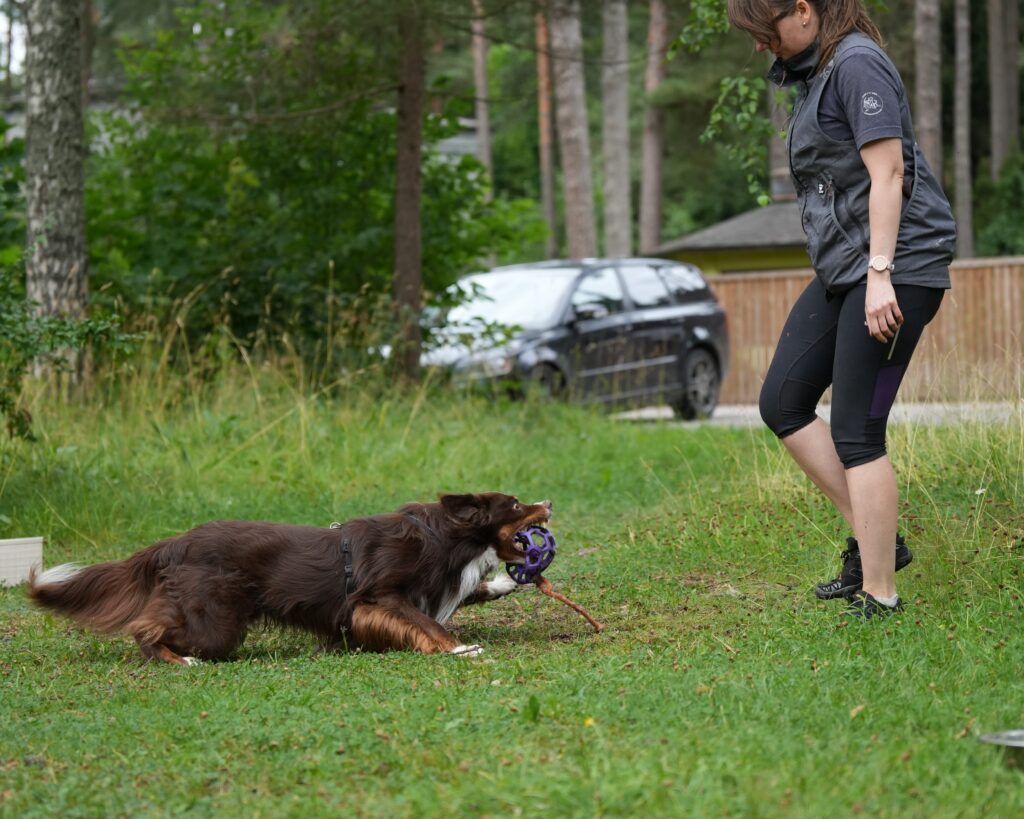
For faster speeds you’ll need a lot more space and bigger, heavier equipment to accommodate the gait adjustment time and for safety. Think about agility courses and how much space there is between obstacles! That’s how much space you’d need between obstacles in Movement Puzzles if done at a faster gait. There’s also a safety challenge – your equipment would need to be heavier and sturdier, properly fixed to the ground, so that it wouldn’t move when there’s more power in the movements.
Got a dog who wants to do everything fast? Who’s also a bit impulsive and tends to make decisions (not always good ones) within split seconds? Your dog goes 0 to 100 in the blink of an eye, tends to get overly excited, so they can’t focus on precision anymore? You’d like to use Movement Puzzles for their dynamic impulse control benefits?
Guess what happens when your dog rushes through Movement Puzzles – their impulse control is switched off! That’s why they rush. For these dogs (and for impulse control and arousal modulation purposes) it’s crucial that the dog does Movement Puzzles at a trot and build some self control into the exercise. Otherwise they will just practice being impulsive over and over again!
Remember that fast moving and easily motivated dogs often use speed to hide mental or physical discomfort with the exercise. Also, slower speeds are often more beneficial when the goal is to improve a dog’s body awareness, balance and coordination. Faster doesn’t always mean better 🙂
2. Movement Puzzles are always based on the pattern of the dog moving independently from bowl to bowl or target to target.
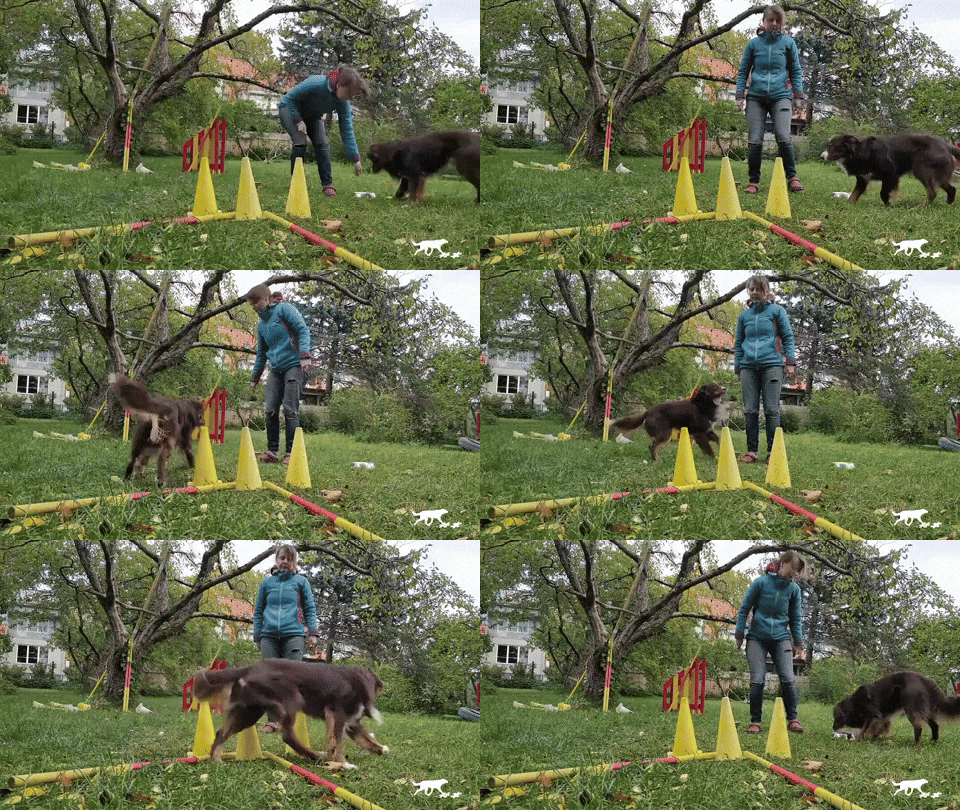
The goal is to remove human interference as much as possible, so that the dog can focus on the exercise and how to best use their body without distractions.
This means that Movement Puzzles are done with:
➡ dog initiating the exercises, not handler cueing the behaviors
➡ no luring or human guiding the dog through the exercise
➡ no human interruption during the exercise like telling the dog they made a mistake or otherwise drawing the dog’s attention from doing the exercise to focusing on the human guidance.
Following these instructions is crucial for Movement Puzzles to actually work as a body awareness and coordination exercise, so that the dog can fully focus on the exercise in front of them and adjusting their body and movement to best solve the obstacles in front of them! Like in the story of how Movement Puzzles were born – if handler cues helped, then Mr Bo wouldn’t have developed a problem with tight turns in the first place!
Focusing on what the human “says” would mean multitasking, split attention or the dog not being able to process the exercise and only getting very limited body awareness and coordination skill benefits.
Plus, if you want these exercises to actually carry over to real life situations and your dog feeling more confident in their own skills when facing challenges, then they need to have the opportunity to practice this on their own. That’s what Movement Puzzles are for!
3. The dog always gets the reward, even if they didn’t do the exercise as you had planned.
In Movement Puzzles we never use forced choice by blocking all the alternative options for the dog (like blocking the option to go around the setup by doing the exercise near a wall) or by only giving rewards for the “correct” behavior.
Why? Because Movement Puzzles are supposed to be confidence boosting exercises. If your dog doesn’t choose to do the exercise with alternative options available, then this means they don’t feel happy or confident about the exercise!
Instead of asking “How can I get my dog to do this?”, in Movement Puzzles we always want to ask “What do I need to change for my dog to WANT to do this?”.
I notice these “forced choice” actions popping up when people are more focused on getting their dog to do a sequence of different exercises before their dog is ready. Instead of boosting the dog’s confidence for the exercise, they try to create a setup that would remove all alternatives for the dog, so that it would look like the dog is choosing the correct exercise.
Here’s what to do instead. Try to focus on just one exercise at a time and make sure your setups are so easy and so well reinforced, that doing the exercise correctly becomes a no-brainer for your dog! That way you’ll create exercises that become secondary reinforcers and building longer sequences will become super easy!
When choosing a Movement Puzzles class, always make sure the class teaches actual Movement Puzzles and the instructor of the class has taken our Movement Puzzles classes. Especially when you want to take the class for the benefits that my training approach has been proven to offer. There’s a reason behind every training choice I’ve made when developing Movement Puzzles. Random obstacle courses done differently aren’t proven to give you these same benefits, even when people mistakenly call them Movement Puzzles.
I’m always hoping to see you in our Movement Puzzles Academy course! If you prefer in person classes, keep an eye on our Find A Trainer page where I’ll soon list people, who have trained Movement Puzzles with me and offer in person classes!
Happy training!
Mari Valgma, the creator of Movement Puzzles™
Excellent! This helps clarify why I feel uncomfortable watching certain videos of folks who say they’re doing “movement puzzles” thank you, Mari.